
Key takeaways
- Anime gives you emotionally rich, context-heavy Japanese that flashcards and textbooks cannot teach.
- Choose anime by level: slice-of-life like Shirokuma Cafe and Takagi-san for beginners, character-driven shows like Spy x Family for intermediate.
- Use the 3-pass method per episode: watch for story, study the language, then shadow and speak.
- Save just 5 to 10 words per episode with context, then review them the next day with spaced repetition.
Why Anime Works for Learning Japanese
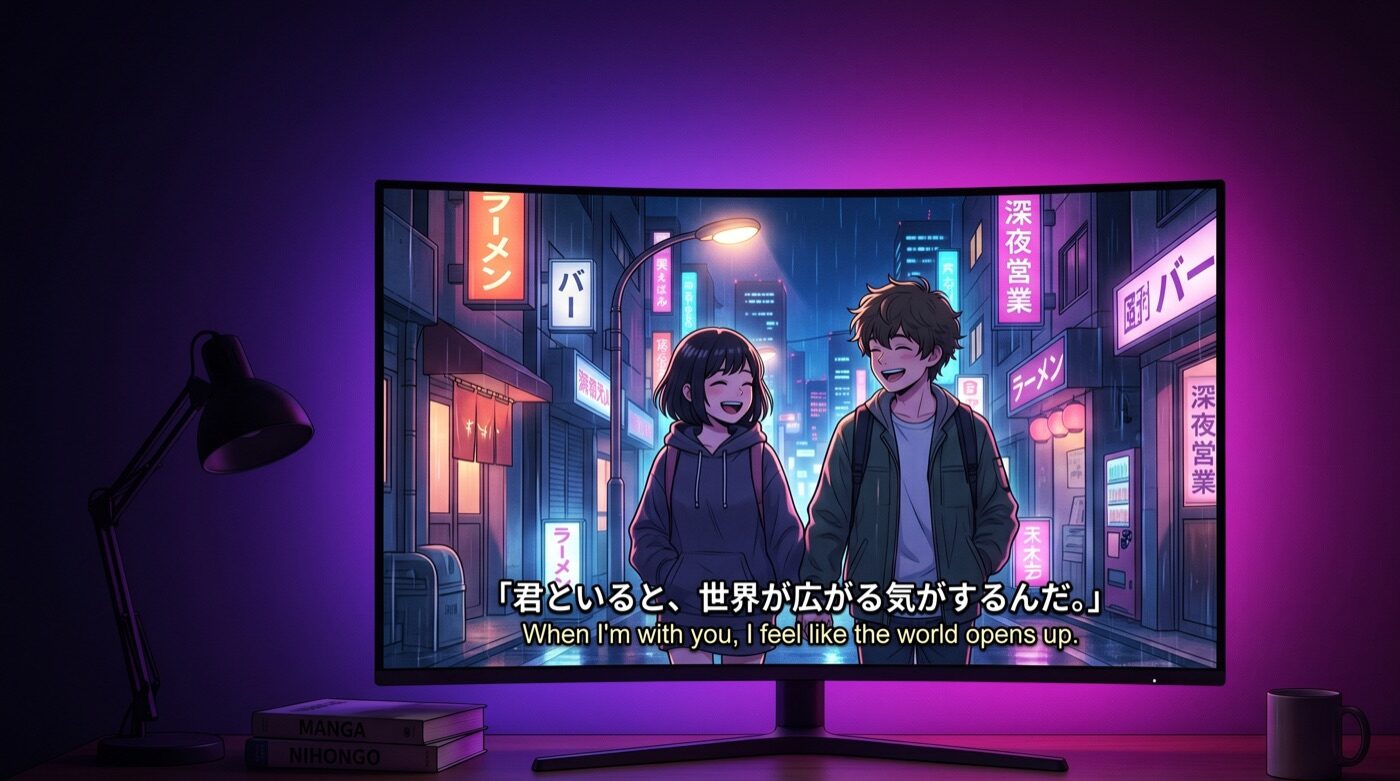
Anime is one of the most accessible windows into spoken Japanese. Unlike textbook audio, anime gives you emotionally rich, context-heavy dialogue. You hear how pitch, tone, and formality shift between characters — something no flashcard deck can teach.
The catch? Watching anime passively will not teach you Japanese. You need a method. This guide gives you one: a structured, daily approach that turns anime episodes into focused language lessons using dual subtitles, shadowing, and active recall.
If you are new to learning through media, start with our overview on how to learn a language by watching for the general principles.
Step 1: Pick the Right Anime for Your Level
Not all anime is created equal for language learning. Action-heavy series with fantasy vocabulary and shouted attack names will not help you order food in Tokyo. Choose anime that matches your current level and uses the type of Japanese you actually want to speak.
Beginner-Friendly Anime
- Shirokuma Cafe (Polar Bear Cafe) — Slow, clear dialogue about everyday topics. Characters speak politely, making it ideal for picking up natural conversational patterns.
- Teasing Master Takagi-san — Simple school-life conversations between two students. Short sentences, common vocabulary, and lots of repetition.
- Chi's Sweet Home — A show about a kitten. Episodes are 3 minutes long, the vocabulary is basic, and the sentences are short. Perfect for absolute beginners.
- Rilakkuma and Kaoru — Gentle slice-of-life with a working adult. Introduces workplace vocabulary and casual speech in a relaxed format.
Intermediate Anime
- March Comes in Like a Lion — Rich character-driven dialogue about life, loss, and relationships. Great for emotional vocabulary and keigo (polite speech).
- Barakamon — A calligrapher moves to a rural island. Mix of standard and regional Japanese, plus lots of natural, unscripted-feeling conversations.
- Silver Spoon — Agricultural school setting. Introduces topic-specific vocabulary while keeping dialogue grounded and conversational.
- Spy x Family — A mix of formal and casual speech. The family dynamic introduces vocabulary around home, school, and social situations.
Step 2: Set Up Dual Subtitles
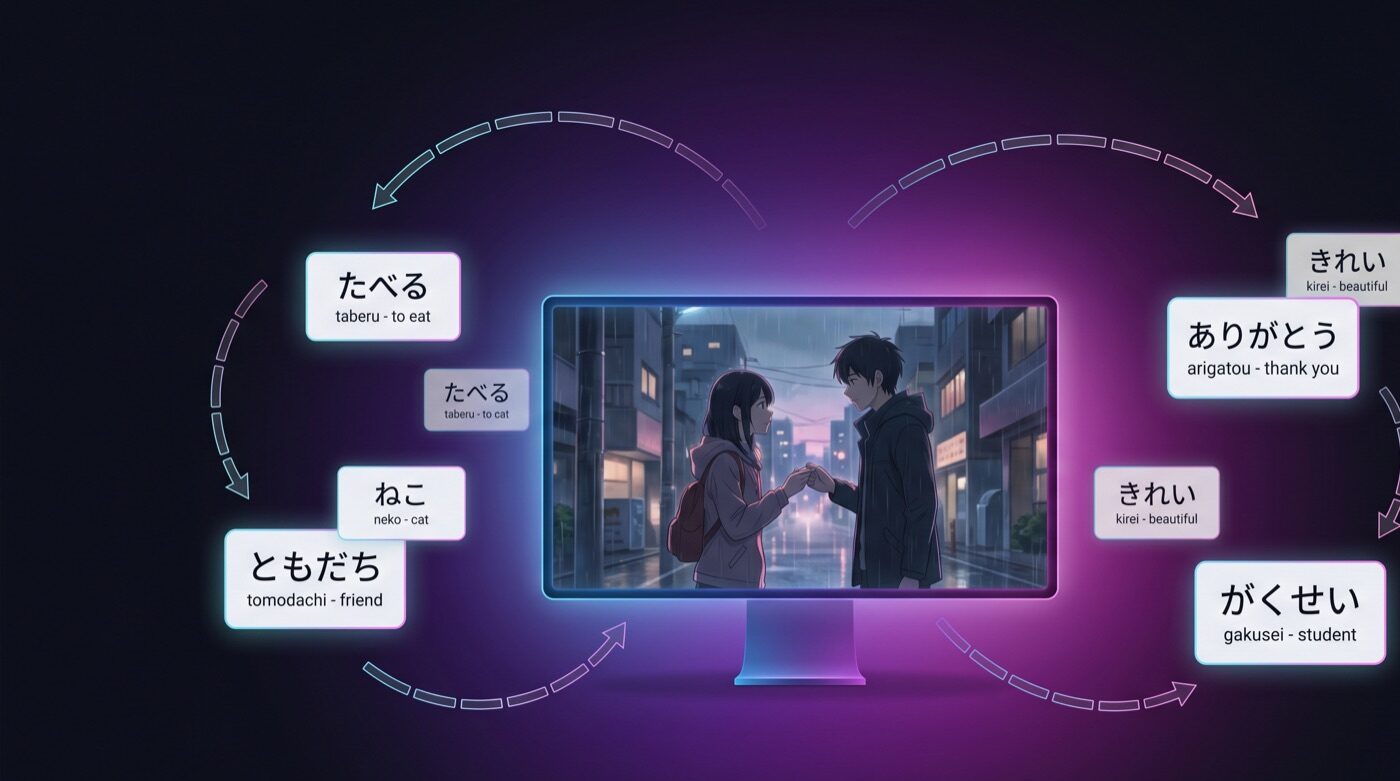
The foundation of this method is watching with two sets of subtitles: Japanese and your native language displayed simultaneously. This lets you read the original Japanese text while immediately checking meaning below it — no pausing, no tab-switching, no dictionary apps.
Funlingo adds dual subtitles to YouTube for free. Many anime episodes, clips, and full series are available on YouTube with Japanese subtitles. Install the Funlingo Chrome extension, open a video, and select your target and native languages.
For a deeper look at dual subtitle tools, see our comparison of the 7 best dual subtitle extensions.
Quick Setup
- Install Funlingo from the Chrome Web Store
- Open any anime video on YouTube
- Click the Funlingo icon and select Japanese + your native language
- Both subtitle tracks appear on screen as the video plays
Step 3: The 3-Pass Episode Method
Watching an episode once is entertainment. Watching it three times with different focus areas is a language lesson. Here is how to structure your passes for maximum retention.
Watch for Story
First pass: dual subtitles on. Focus on understanding the story. Do not pause or look things up. Let your brain absorb the sounds and patterns naturally.
Study the Language
Second pass: pause at new words. Click words in Funlingo to see definitions. Save 5 to 10 words to your vocabulary list. Read the Japanese subtitle before checking the translation.
Shadow and Speak
Third pass: Japanese subtitles only. Pause after each line and repeat it out loud, matching the speaker's rhythm and intonation. This is shadowing — it builds pronunciation and recall.
You do not need to do all three passes in one sitting. Spread them across the day: watch during lunch, study after dinner, shadow before bed.
Step 4: Use Shadowing to Build Pronunciation
Shadowing is the single most effective technique for improving your Japanese pronunciation. The concept is simple: listen to a line, pause, and repeat it out loud as accurately as you can. Match the rhythm, pitch accent, and emotion of the original speaker.
How to Shadow Effectively
- Start with short lines. One sentence at a time. Do not try to shadow entire conversations at first.
- Mimic emotion, not just words. If the character sounds excited, sound excited. Emotion carries pitch patterns that are critical in Japanese.
- Record yourself occasionally. Compare your recording to the original. You will notice gaps you cannot hear in real time.
- Focus on common phrases first. Greetings, reactions, and everyday expressions give you the most practical value early on.
Step 5: Build Vocabulary with Context
When you encounter a new word in anime, you are not learning it in isolation. You hear the pronunciation, see the written form, understand the context, and feel the emotional tone. This multi-layered input is far more memorable than a flashcard with a single translation.
Vocabulary Strategy
- Save 5 to 10 words per episode. More than that and you will not retain them. Quality over quantity.
- Use Funlingo's word-saving feature. Click any word in the dual subtitles to see its meaning and save it for later review.
- Review saved words the next day. Spaced repetition means reviewing before you forget, not after. Next-day review locks words into long-term memory.
- Note the sentence, not just the word. Context is what makes a word stick. Save the whole line where you heard it.
For a deeper dive into vocabulary methods, read our guide on how to build vocabulary while watching shows.
Step 6: A Sample 30-Minute Daily Routine
Consistency matters more than session length. Here is a realistic 30-minute daily routine you can maintain long-term.
Common Mistakes to Avoid
Frequently Asked Questions
Yes, anime provides authentic spoken Japanese with emotional context. Combined with dual subtitles and active study methods like shadowing, it is an effective supplement to structured learning.
Start with slice-of-life anime like Shirokuma Cafe, Teasing Master Takagi-san, or Chi's Sweet Home. These use everyday vocabulary and slower, clearer speech.
Some anime uses exaggerated or archaic speech patterns. Slice-of-life and drama genres are closest to everyday conversational Japanese.
With consistent daily practice, most learners start catching common phrases within 2 to 3 months and can follow simple slice-of-life dialogue within 6 to 12 months.
Use dual subtitles with Japanese and your native language side by side. Funlingo provides this for free on YouTube.