Key takeaways
- There is no magic shortcut, but the fastest path is structured basics plus daily immersion from week one.
- Learn the kana (hiragana and katakana) first — it takes about two weeks and unlocks everything else.
- Pair one grammar resource with a spaced-repetition app for vocabulary, then reinforce both with native video.
- Immersion with anime and Japanese shows builds listening and real-world vocabulary faster than textbooks alone.
- Funlingo adds free dual subtitles and click-to-translate to Netflix, YouTube, and Crunchyroll so you learn in context.
If you want to know how to learn Japanese fast, the honest answer is that there is no overnight trick — but there is a much faster path than the one most beginners stumble down. The learners who progress quickest combine a small amount of structured study with a large amount of meaningful immersion, starting almost immediately. This guide lays out a realistic fast-track roadmap, the best apps to learn Japanese, how to use native video for immersion, and exactly how to learn Japanese by yourself with a daily routine you can actually keep.
A Realistic Fast-Track Roadmap
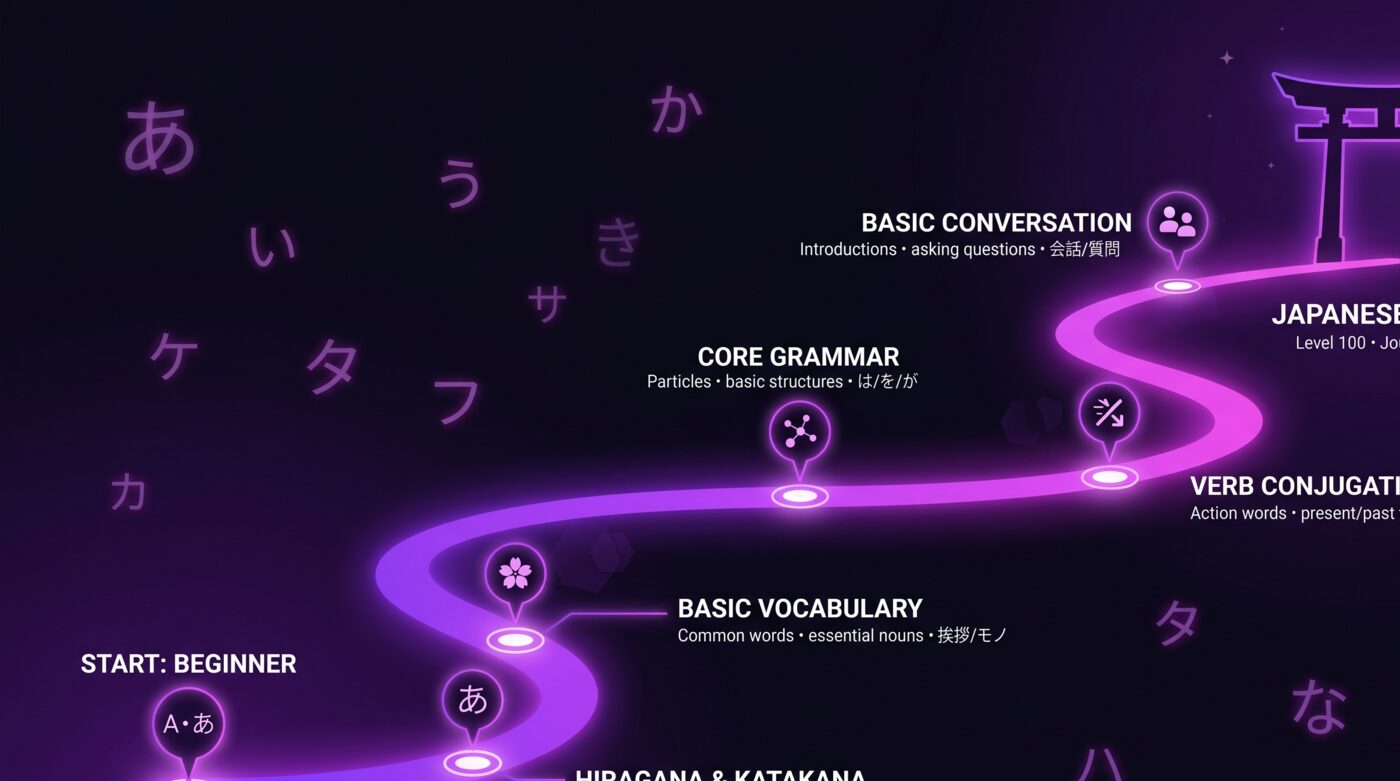
"Fast" in language learning does not mean fluent in a month — it means making visible progress every week and never stalling. The fastest learners front-load the foundations, then spend the bulk of their time exposed to real Japanese. Here is the high-level order of operations that gets beginners speaking and understanding in the shortest realistic time.
- 1
Master the kana
Learn hiragana and katakana in your first two weeks so you can read and pronounce Japanese accurately.
- 2
Core grammar & words
Use one structured app or course for grammar and your first 500-1000 high-frequency words.
- 3
Immerse daily
Watch native video with dual subtitles from week one to train your ears and learn in context.
- 4
Output & review
Review vocabulary with spaced repetition and start speaking or shadowing what you hear.
Notice that immersion does not wait until you are "ready." Starting native input early — even when you understand almost nothing — is one of the biggest accelerators, because it trains your ear to Japanese rhythm and sounds long before your grammar catches up.
Learn the Kana First
Before anything else, learn the two Japanese syllabaries: hiragana (used for native words and grammar) and katakana (used mostly for foreign loanwords). Together they cover every sound in the language, and unlike kanji there are only about 46 basic characters in each set. Most beginners can read both within two weeks of focused practice.
Skipping the kana and leaning on romaji (Japanese written in the Latin alphabet) is the single most common mistake that slows beginners down. Romaji feels easier at first, but it builds bad pronunciation habits and means you have to relearn everything later. Use mnemonics and a quick daily drill, and the kana stick fast.
What About Kanji?
Kanji — the thousands of Chinese-derived characters — is the part that intimidates people most. The trick is not to attack it all at once. Learn the most common kanji gradually alongside the vocabulary you are already studying, ideally with a spaced-repetition system. You do not need to memorize 2,000 characters before you can start understanding Japanese; you pick them up steadily as you read and watch.
Best Apps to Learn Japanese
No single app is the whole answer, but the right combination covers grammar, vocabulary, and reading efficiently. When people ask for the best app to learn Japanese, what they really need is one tool for each job rather than one tool for everything.
- A structured grammar course or app to walk you through the building blocks in a logical order, so you are not guessing how sentences fit together.
- A spaced-repetition app (an SRS like Anki or a built-in flashcard system) to lock vocabulary and kanji into long-term memory with minimal daily effort.
- A gamified beginner app for quick daily reps and motivation when you only have a few minutes.
- An immersion tool like Funlingo to turn the shows you already watch into comprehensible, clickable Japanese practice.
Stack tools, don't collect them
Immersion With Native Video (Free Dual Subtitles via Funlingo)
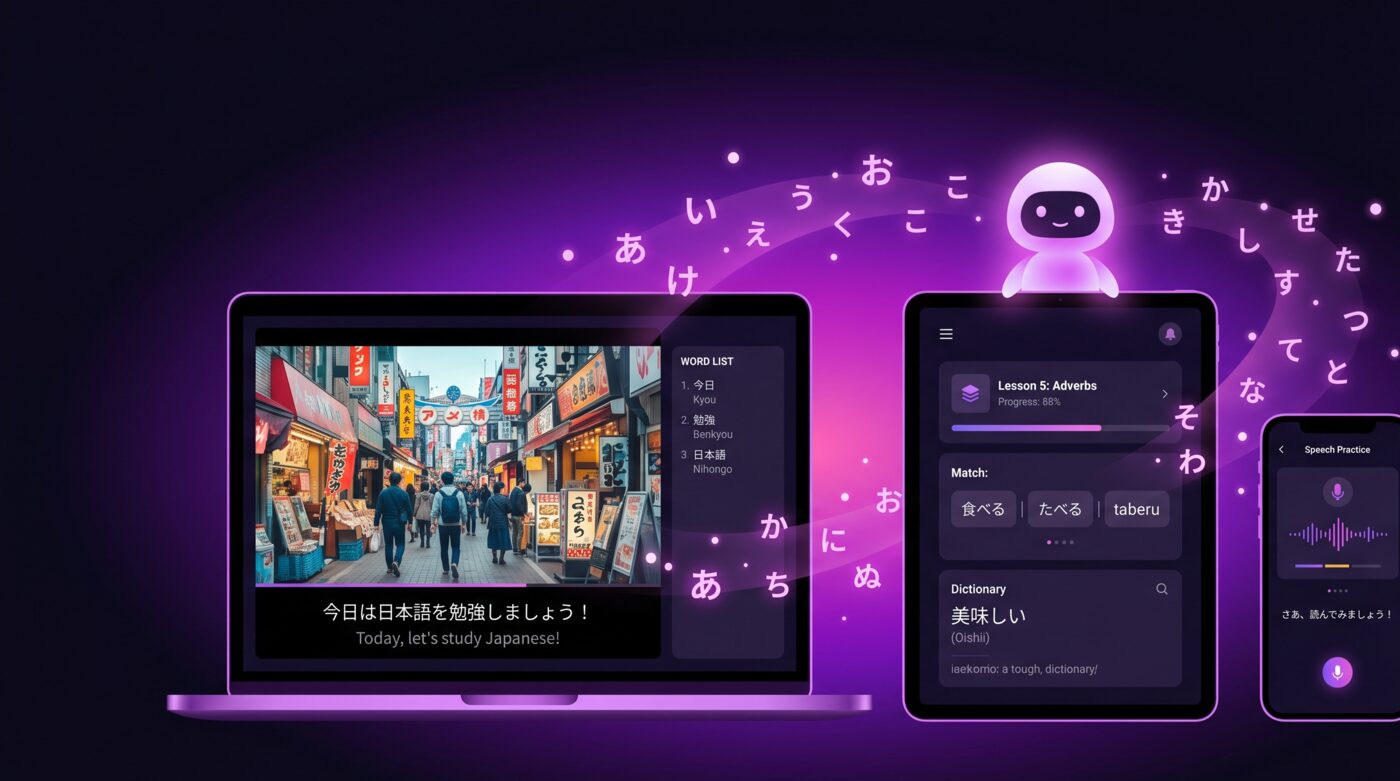
Apps and textbooks teach you the system; immersion teaches you the language as people actually use it. And there is no more enjoyable form of immersion than watching native Japanese video — anime, dramas, variety shows, and YouTube. The challenge has always been that raw native content is too hard for beginners, while learner content is too slow to be interesting. Dual subtitles solve exactly that gap.
Funlingo is a free Chrome extension that adds dual subtitles and AI translation directly to the player on Netflix, YouTube, Amazon Prime Video, and Crunchyroll. You see Japanese and your own language at the same time, and you can click any word in the subtitles to get an instant definition, reading, and meaning in context. That turns an episode you would watch anyway into focused, comprehensible practice — no quota, no paywall on the core experience.
Anime is an especially good starting point because the speech is often clear, the visuals carry the meaning, and there is a huge range of difficulty. Slice-of-life shows tend to use everyday conversational Japanese that transfers straight into real life. For a deeper walkthrough, see our guide on how to learn Japanese from anime, and if Crunchyroll is your platform of choice, read learning Japanese with Crunchyroll. Netflix users will also find plenty in our broader Netflix language learning guide.
Seeing the Japanese and the translation together means you never lose the plot, and clicking a word you do not know turns a moment of confusion into a vocabulary win. Over dozens of episodes, those small wins compound into real listening ability. Install it from the Chrome extension page and add it to whatever you are already watching.
How to Learn Japanese by Yourself
You do not need a classroom or a tutor to make fast progress. Plenty of learners reach conversational and even advanced levels entirely through self-study — the difference between those who succeed and those who give up is structure and consistency, not talent. Here is how to learn Japanese by yourself without losing direction.
Anchor yourself to one grammar resource so you always know what to study next. Use spaced repetition daily so vocabulary actually sticks. Immerse in native content you genuinely enjoy so you keep showing up. And practice output early — talk to yourself, shadow lines from your shows, or write short sentences. Input plus a little output beats endless passive study.
A Daily Routine That Sticks
Consistency beats intensity. Thirty to sixty focused minutes a day, every day, will outpace a three-hour cram session once a week. A simple daily routine that works for beginners looks like this:
- 1
5-10 min SRS
Clear your spaced-repetition reviews first so vocabulary and kanji stay fresh.
- 2
10-15 min grammar
Work through one short lesson or section from your main grammar resource.
- 3
15-25 min immersion
Watch one scene or short episode with Funlingo dual subtitles, clicking new words.
- 4
5 min output
Shadow a few lines aloud or write two or three sentences using what you learned.
On busy days, shrink the routine rather than skipping it — even five minutes of SRS keeps the habit alive. The learners who improve fastest are simply the ones who never let two days in a row go by without touching Japanese.
Set a concrete first milestone
Frequently Asked Questions
How long does it take to learn Japanese?
It depends on your goals and daily study time. Comfortable conversational ability (around JLPT N4-N3) usually takes 1 to 2 years of consistent study, while business-level fluency (N1) often takes 3 to 5 years or more. The Foreign Service Institute estimates roughly 2,200 hours for English speakers to reach professional proficiency. With 30 to 60 focused minutes a day plus immersion, basic conversations come within a few months.
How hard is it to learn Japanese?
Japanese is one of the harder languages for English speakers, mainly due to its three writing systems, pitch accent, and grammar that differs greatly from English. But pronunciation is relatively simple, there are no genders or plurals to memorize, and the kana can be learned in a couple of weeks. The difficulty is real but very manageable with the right methods and steady daily practice.
How do I start learning Japanese?
Start with the two kana syllabaries, hiragana and katakana, to build your sound and reading foundation. Then pick up core grammar and your first few hundred words with a structured app, and add a spaced-repetition system for vocabulary. Begin light immersion almost immediately — native video with dual subtitles trains your ears and shows real Japanese in context. Then keep a short daily routine consistent.
Can you learn Japanese by yourself?
Yes. Many learners reach conversational and even advanced levels entirely through self-study. The keys are a structured grammar resource, daily vocabulary review with spaced repetition, and consistent immersion in native content like anime and YouTube. Tools like Funlingo make self-study easier by adding dual subtitles and click-to-translate to the shows you already watch, so you learn in context without a teacher.