Key takeaways
- DeepL leads accuracy for European languages; Papago dominates Korean; Yandex is strongest for Russian.
- Google Translate has the broadest coverage at 133+ languages with consistently good quality.
- ChatGPT and other LLMs produce the most natural output for nuanced, creative, and culturally sensitive text.
- Free tiers cover most personal needs; paying mainly buys glossaries, document formatting, and higher API limits.
- Funlingo offers free contextual translation while you watch, with dual subtitles and click-to-translate.
AI translation has advanced dramatically in recent years. What once produced laughably bad output now delivers translations that rival professional human work for many language pairs. But with so many AI translator tools available, from established giants like Google Translate and DeepL to newcomers powered by large language models, choosing the right one can be overwhelming. This comprehensive guide compares the 10 best AI translators of 2026, covering accuracy, pricing, language support, and ideal use cases for each. Whether you're looking for the best AI translation tool for professional documents, a free AI language translator for casual use, or an AI-powered translation tool for learning — this guide covers your options.
The 10 Best AI Translator Tools for 2026
1. Google Translate
The most widely used AI translator in the world, Google Translate supports over 130 languages and handles text, documents, images, speech, and real-time conversation. Powered by Google's Neural Machine Translation (NMT) system, it has improved significantly since its early statistical days. Google Translate is deeply integrated into Chrome, Android, and Google's ecosystem, making it the default choice for billions of users.
2. DeepL
DeepL has built its reputation on translation quality. Founded in Germany in 2017, it consistently outperforms Google Translate in blind tests for European languages like German, French, Spanish, and Dutch. DeepL excels at preserving natural phrasing, handling idioms, and maintaining the tone of the original text. Its paid tiers add document translation (preserving formatting), glossary customization, and higher API limits.
3. Funlingo (Contextual Translation While Watching)
Funlingo approaches AI translation from a unique angle: contextual translation while watching video content. Rather than translating text you paste into a box, Funlingo works inside Netflix, YouTube, and Amazon Prime Video to provide dual subtitles and instant word-level translations. Click any word in the subtitles to see its meaning, pronunciation, and usage. This makes it uniquely powerful for language learners who want to understand content in real time rather than translating text after the fact. For dual subtitles on Netflix, YouTube, and Prime Video, check out our dual subtitles setup guide. If you prefer building vocabulary through video content, see our guide to Netflix language learning extensions.
4. ChatGPT (OpenAI)
ChatGPT is not a traditional translator, but its large language model capabilities make it an exceptionally flexible translation tool. You can ask ChatGPT to translate text, explain nuances, adjust formality levels, translate while preserving a specific tone, or provide multiple translation options with explanations of the differences. It understands context in ways that traditional NMT systems cannot, making it ideal for ambiguous or culturally sensitive content.
5. Microsoft Translator
Microsoft Translator is deeply integrated into the Microsoft ecosystem: Outlook, Word, Excel, PowerPoint, Edge browser, Teams, and Skype all use it. It supports over 120 languages and offers features like multi-person conversation translation (up to 100 people), image translation, and offline language packs. For businesses already in the Microsoft ecosystem, it is the most seamless choice.
6. Apple Translate
Built into iOS, iPadOS, and macOS, Apple Translate prioritizes privacy by processing translations on-device whenever possible. It supports text and conversation translation with a clean, minimal interface. Safari's built-in page translation also uses this engine. While it supports fewer languages than Google or Microsoft, its on-device processing means it works without an internet connection and your data never leaves your device.
7. Papago (Naver)
Developed by Korean tech giant Naver, Papago is the gold standard for Korean translation. It significantly outperforms Google Translate and DeepL for Korean-English, Korean-Japanese, and other Korean language pairs. Papago also handles Japanese and Chinese well, and includes features like image translation, voice input, and a built-in dictionary with example sentences. If you are learning Korean or working with Korean content, Papago is indispensable.
8. Yandex Translate
Russia's leading search engine also runs one of the better AI translation services, particularly for Russian and other Slavic languages. Yandex Translate supports over 100 languages, offers document and website translation, and includes image translation via its mobile app. It is the best choice for Russian-English and Russian-European language pairs.
9. iTranslate
iTranslate is a polished mobile-first translator with a strong focus on user experience. It supports text, voice, camera, and conversation translation across over 100 languages. The Pro version adds offline translation, website translation via a Safari extension, and voice-to-voice conversation mode. It is particularly popular among travelers for its clean interface and reliable offline capabilities.
10. Reverso
Reverso stands out from other translators by combining translation with language learning features. It shows translations in context with real-world example sentences, conjugation tables, synonym suggestions, and grammar explanations. The Reverso Context feature is particularly valuable: it searches a massive database of bilingual texts to show how words and phrases are actually used in authentic content.
Comparison Summary
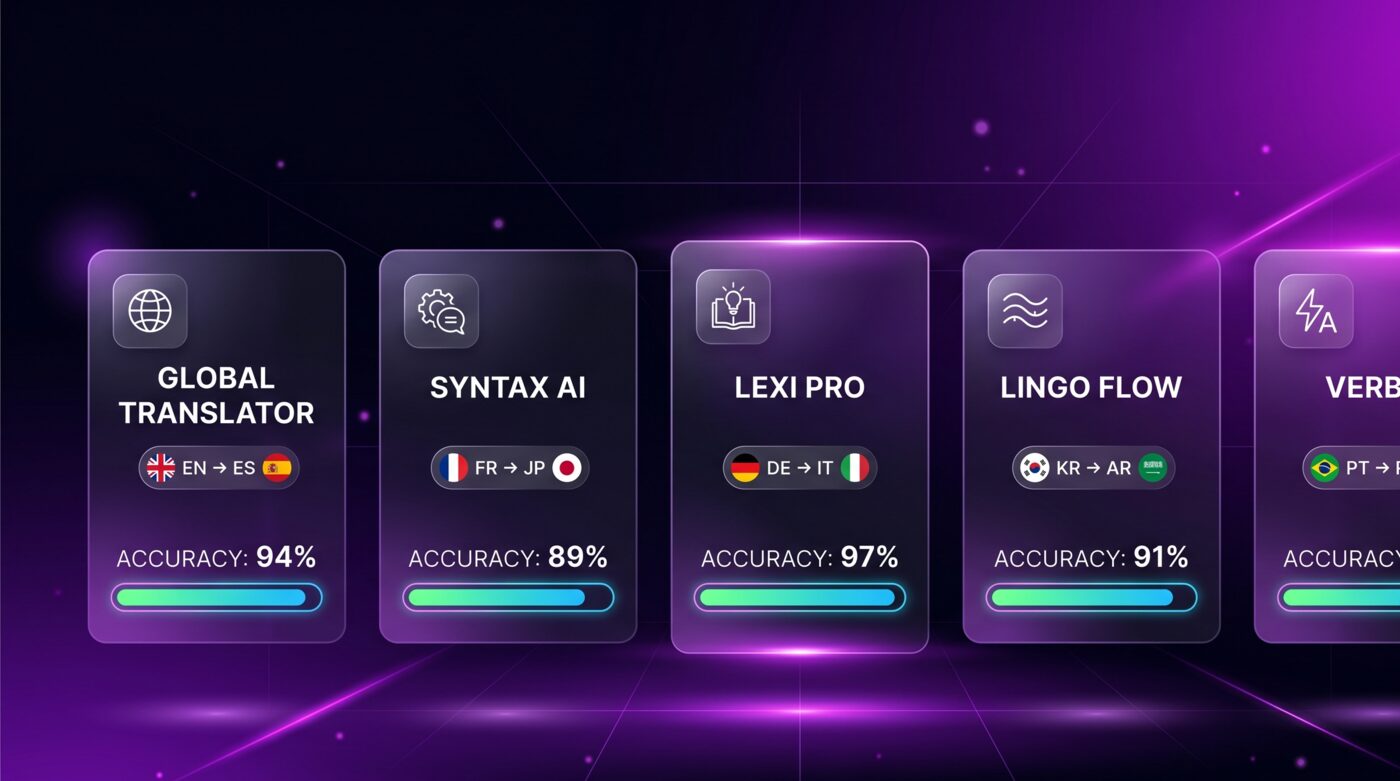
Here is a quick breakdown to help you choose the right AI translator for your specific needs:
| Tool | Best For | Languages | Free Tier |
|---|---|---|---|
| Google Translate | Broadest coverage | 133+ | Yes |
| DeepL | European accuracy | 33 | Yes (limited) |
| Funlingo | Video learning | All platform | Yes (full) |
| ChatGPT | Nuanced / creative | 90+ | Yes (limited) |
| Microsoft Translator | Microsoft ecosystem | 120+ | Yes |
| Apple Translate | Privacy / Apple users | 20 | Yes |
| Papago | Korean / CJK languages | 15 | Yes |
| Yandex Translate | Russian / Slavic | 102 | Yes |
| iTranslate | Mobile / travel | 100+ | Yes (limited) |
| Reverso | Context / learning | 18 | Yes |
How to Choose the Right AI Translator
The best AI translator depends entirely on your use case. Here is a decision framework to help you choose:
Test before you commit
Not all translators are equal across languages. DeepL leads for European pairs. Papago dominates Korean. Yandex excels at Russian. Google and Microsoft have the broadest coverage. If you work with a specific language pair regularly, test multiple tools with the same passage and compare results.
Dedicated translation tools like Google Translate and DeepL return results in milliseconds. LLM-based translators like ChatGPT take seconds per request. For real-time needs like conversation translation or live subtitles, speed matters. For document translation where you can wait, quality matters more.
For personal use, free tiers are often sufficient. Google Translate has the most generous free tier with no character limits on the web interface. For API access or business use, compare pricing per character carefully. DeepL Pro, Microsoft Azure, and Google Cloud Translation all have different pricing structures and minimum commitments.
Technical documentation benefits from tools with glossary features (DeepL, Microsoft Custom Translator). Creative and marketing text works best with LLMs like ChatGPT that understand tone and style. Language learning pairs well with contextual tools like Reverso and Funlingo. Legal and medical translation should always include human review regardless of the AI tool used.
If you need translation inside specific workflows, check integrations. Microsoft Translator is unmatched for Office and Teams. Google Translate integrates with Chrome and Android. DeepL has browser extensions and desktop apps. Funlingo integrates directly into streaming platforms. The best tool is the one that fits where you already work. If you're specifically looking for alternatives to Immersive Translate, see our dedicated alternatives guide.
The Future of AI Translation
AI translation is evolving rapidly, and several trends are shaping its future:
Large language models like GPT-4, Claude, and Gemini understand context, culture, and intent in ways that traditional NMT systems cannot. They can handle ambiguity, maintain consistent tone across documents, and even explain their translation choices. As these models become faster and cheaper, they will increasingly replace traditional translation engines for high-quality use cases.
Translation is expanding beyond text. Real-time speech-to-speech translation, video subtitle generation, and augmented reality translation (point your phone at a sign and see the translation overlaid) are all rapidly improving. Tools like Funlingo represent this trend by providing real-time contextual translation within video content rather than requiring users to copy text into a separate tool.
Future AI translators will learn your preferences: your preferred vocabulary, formality level, industry jargon, and style. DeepL's glossary feature is an early example, but LLMs will take this much further, producing translations that sound like they were written by you specifically. This personalization will blur the line between translation and writing assistance.
Which AI Translator Is the Most Accurate?
The most accurate AI translator depends on your language pair. For European languages like German, French, Spanish, and Dutch, DeepL consistently outperforms every other tool in blind accuracy tests. For Korean, Papago is significantly more accurate than Google or DeepL. For Russian and Slavic languages, Yandex Translate leads. For nuanced, context-heavy translations where tone and intent matter — marketing copy, creative writing, literary text — ChatGPT and other LLMs produce the most natural output. Google Translate remains the best all-around choice when you need broad language coverage (133+ languages) with consistently acceptable quality.
Free AI Translation Tools vs Paid: Is It Worth Upgrading?
For personal use, free AI translators handle most needs well. Google Translate has no character limits on its web interface and covers 133 languages. Funlingo provides free contextual translation while watching videos. Apple Translate works offline on Apple devices. The main reasons to pay are: higher accuracy for professional work (DeepL Pro at $8.74/month), custom glossaries for consistent terminology, document translation with formatting preservation, and higher API limits for developers. If you translate fewer than a few thousand words per day for personal or learning purposes, free tools are sufficient.
Frequently Asked Questions
What is the most accurate AI translator?
It depends on the language pair. DeepL is widely regarded as the most accurate for European languages like German, French, Spanish, and Dutch. For Korean, Papago leads. For Russian, Yandex is strongest. For nuanced, context-heavy translations, ChatGPT and other LLMs often produce the most natural results, though they are slower. For the broadest coverage with consistently good quality, Google Translate remains the safest all-around choice.
Is DeepL better than Google Translate?
For European languages, yes. Blind tests consistently show that DeepL produces more natural, fluent translations for language pairs like English-German, English-French, and English-Spanish. DeepL handles idioms, register (formal vs informal), and complex sentence structures more gracefully. However, Google Translate supports over four times as many languages, has better mobile apps, and is more deeply integrated into everyday tools. For non-European languages, Google often matches or exceeds DeepL.
Are AI translators replacing human translators?
Not yet, but the relationship is changing. For casual communication, travel, content consumption, and rough understanding, AI translation is already good enough for most people. However, professional translation for legal contracts, medical documents, literary works, and marketing campaigns still requires human expertise for accuracy, cultural sensitivity, and liability. The dominant professional model is now AI-assisted translation, where AI produces a first draft and a human translator edits and refines it. This hybrid approach is faster and cheaper than fully manual translation while maintaining human-level quality.